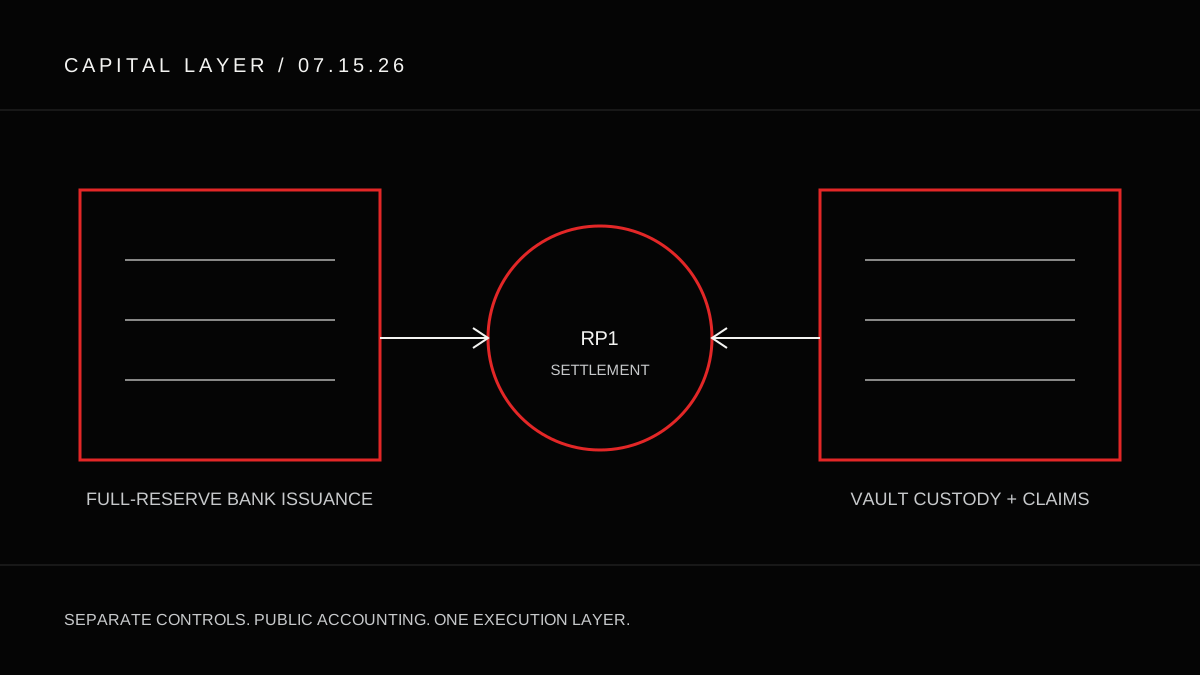
Two new capital primitives landed together, but they solve different problems.
RP1 Bank gives an approved institution a full-reserve issuance path. Native Vaults give applications deterministic share accounting, isolated custody, and bounded asynchronous redemptions. They use the same settlement layer without sharing authority or blurring their accounting.
RP1 Bank
An issued institutional stablecoin must keep total supply equal to total reserves. Minting deposits the configured reserve denomination before circulation increases. Pausing issuance does not close redemption, and the bank/ denomination namespace is reserved for this facility across the chain.
That means the public coverage query, issuer role, supply cap, pause control, and redemption path have to agree. A dashboard balance is not the reserve model; chain state is.
Native Vaults
Vaults V1 is an idle-asset accounting kernel. Each vault has deterministic custody and claim escrow accounts, a single share denomination, virtual offsets, and donation quarantine. Raw transfers into custody do not silently manipulate share price.
Redemptions enter bounded epochs. A user can set a minimum asset output and cancel before settlement. During settlement, a stale minimum or zero-output request is cancelled individually and its shares are refunded, so one request cannot freeze everyone else’s exit.
The module includes native messages, queries, REST, gRPC, AutoCLI, governance operations, and TypeScript SDK workflows. Existing networks require the named vaults-v1 upgrade before the store is active.
V1 does not send assets into lending, DEX strategies, leverage, arbitrary contracts, cross-chain execution, or agent control. Those paths need separately reviewed typed adapters. The boundary is deliberate.
The public product page is available at rp.one/vaults.
Source record
- RP1 Bank institutional issuancepull request / 2026-07-15
- Native RP1 Vaultspull request / 2026-07-15